NSW Selective High School Placement Test

  1. Year 5, nowYou are here

    A year of runway, which is the whole reason to spend it on the Year 4 gaps rather than on the Year 6 book your child cannot open yet.

  2. Year 5, later

    The gaps close one at a time. Each one opens more of the Year 6 books, and the checker below tells you which chapter opens the most.

  3. Year 6

    The test is sat in Year 6, for Year 7 entry. Check the Department for that cycle’s application window and test dates — we deliberately do not reprint them here, because a stale date is worse than none.

  4. Test day

    Four sections, 93 questions, 155 minutes of working time, and all four sections worth 25% each — including the single writing question.

Free Selective test practice in Year 5, a year before the test

Our two Selective practice books are free and complete, and they are written for Year 6. That is the problem a Year 5 family runs into on page one: the Mathematical Reasoning book opens on percentages, then ratio, then negative numbers. Rather than tell you to wait a year, this works out which chapters do not need any of that yet.

Check which chapters are open

Free Selective test practice a Year 5 child can start on

Free Selective test practice Year 5 families can use tonight has to work around one fact: these books are written for Year 6. So instead of a reading order that assumes the whole book is available, tick what your child can already do and the widget works out which chapters that opens.

The checker runs in this page and the answer changes as you tick. Your ticks are not sent anywhere. Like every page here it does count anonymous page views, which is a different thing and is described in our privacy policy.

Tick the Year 4 chapters your child could sit down and do today. The ticks stay in this browser tab: nothing about your child is sent anywhere or stored. Do not guess upward: an unticked box costs you nothing but a chapter of revision, and a wrongly ticked one sends them into a Year 6 chapter they are not ready for.

Mathematical Reasoning
Thinking Skills

1of 17Year 6 chapters open today

Nothing ticked yet, so this is the floor: one Year 6 chapter stands on nothing the Year 4 book teaches, so there is no run-up to do first. That is not the same as it being easy. Tick a box and the rest starts to move.

Open now (1)

  • Negative numbersMathematical Reasoningnothing in the Year 4 book leads into this one, so it starts cold

Do a Year 4 chapter first (16)

  • Percentages of an amountMathematical Reasoningafter Fractions of an amount
  • Increase and decreaseMathematical Reasoningafter Fractions of an amount and Money
  • Sharing in a ratioMathematical Reasoningafter Sharing & remainders and Fractions of an amount
  • Speed, distance and timeMathematical Reasoningafter Time and Changing units
  • Letters standing in for numbersMathematical Reasoningafter Working backwards and Order of operations
  • Area of triangles and odd shapesMathematical Reasoningafter Perimeter & area
  • How likely is it?Mathematical Reasoningafter Fractions of an amount
  • Two-step word problemsMathematical Reasoningafter Order of operations and Working backwards
  • Harder patternsMathematical Reasoningafter Number patterns
  • Ordering five and six thingsThinking Skillsafter Putting things in order
  • Codes with two stepsThinking Skillsafter Letter codes
  • Three overlapping groupsThinking Skillsafter Groups that overlap
  • Ruling things outThinking Skillsafter Ruling things out
  • Days a long way outThinking Skillsafter Days of the week
  • Balancing three thingsThinking Skillsafter Balancing scales
  • Machines that do two thingsThinking Skillsafter Finding the rule

The map behind the answer

The whole thing, in one table, so you can disagree with it. Each Year 6 chapter sits next to the Year 4 chapter or chapters it stands on, and the reason we think so. If a row looks wrong to you, trust your own read of your own child over ours.

QuizPaste’s own reading of its own two books’ chapter lists. Not the Australian Curriculum, not the Department, not reviewed by a teacher. Scroll sideways on a narrow screen.
Year 6 chapterStands on (Year 4 chapter)Why
Percentages of an amountFractions of an amounta percentage of an amount is a fraction of an amount in other clothes
Increase and decreaseFractions of an amount and Moneyyou have to find the part before you can add or take it off
Sharing in a ratioSharing & remainders and Fractions of an amounta ratio is sharing where the shares are not equal
Speed, distance and timeTime and Changing unitsthe arithmetic is easy and the units are what catch people out
Negative numbersNothing — new groundnothing in the Year 4 book leads into this one, so it starts cold
Letters standing in for numbersWorking backwards and Order of operationsundoing a calculation is the same move, written with a letter in it
Area of triangles and odd shapesPerimeter & areait extends rectangles to shapes you have to cut up first
How likely is it?Fractions of an amountchance is written as a fraction, so fractions come first
Two-step word problemsOrder of operations and Working backwardstwo steps means deciding which one goes first
Harder patternsNumber patternssame idea, longer rules
Ordering five and six thingsPutting things in orderthe same puzzle with more things to keep straight
Codes with two stepsLetter codesa one-step code has to be automatic before two steps is readable
Three overlapping groupsGroups that overlaptwo circles before three
Ruling things outRuling things outthe Year 4 book has this chapter too, at shorter length
Days a long way outDays of the weekcounting a few days ahead before counting hundreds
Balancing three thingsBalancing scalestwo-way balances before three-way ones
Machines that do two thingsFinding the ruleyou have to be able to find one rule before chaining two

Two things the map turned up

  • One Year 6 chapter stands on nothing in the Year 4 book: Negative numbers. That makes it open to a Year 5 child on day one, which is not at all the same as easy. It is open because there is no run-up, not because there is no climb.
  • 4 Year 4 chapters lead nowhere in the Year 6 book Averages, Left, right and next to, The odd one out, Counting positions. They are not wasted; they are on the Opportunity Class path rather than this one. Worth knowing if you are working through the Year 4 book with the Selective test as the goal, because those are the ones to leave until last.

The two free books

This is the whole of our free Selective test practice Year 5 families can reach: two complete books, not sample chapters. No account, no email, no watermark. Worked answers for every question and a plain-English explainer at the start of each chapter, which matters more than usual here: a Year 5 child meeting ratio for the first time needs the explainer, not just the answer.

Mathematical Reasoning

75 pages · 300 questions · answers & working for every one · 1.0 MB PDF

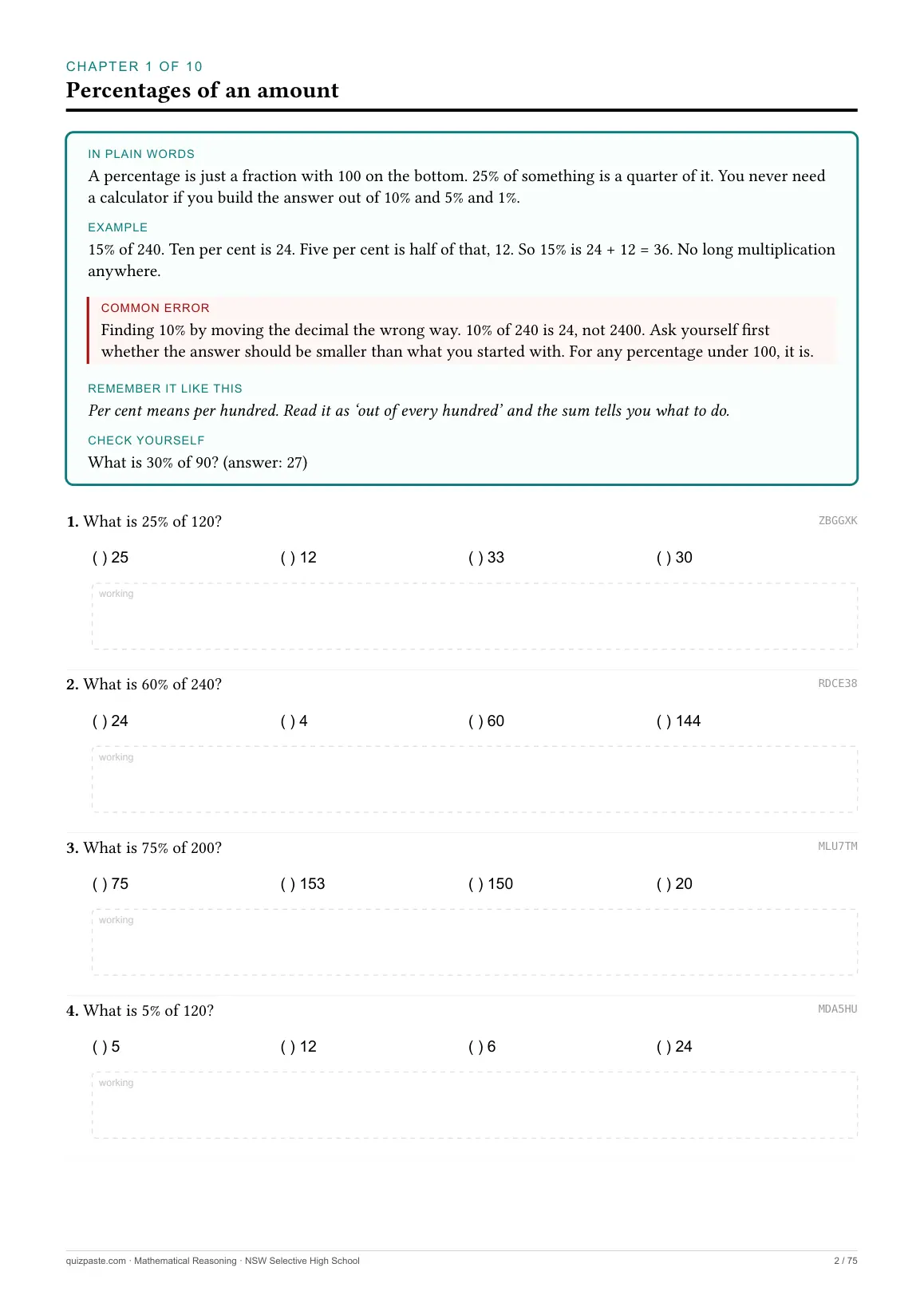
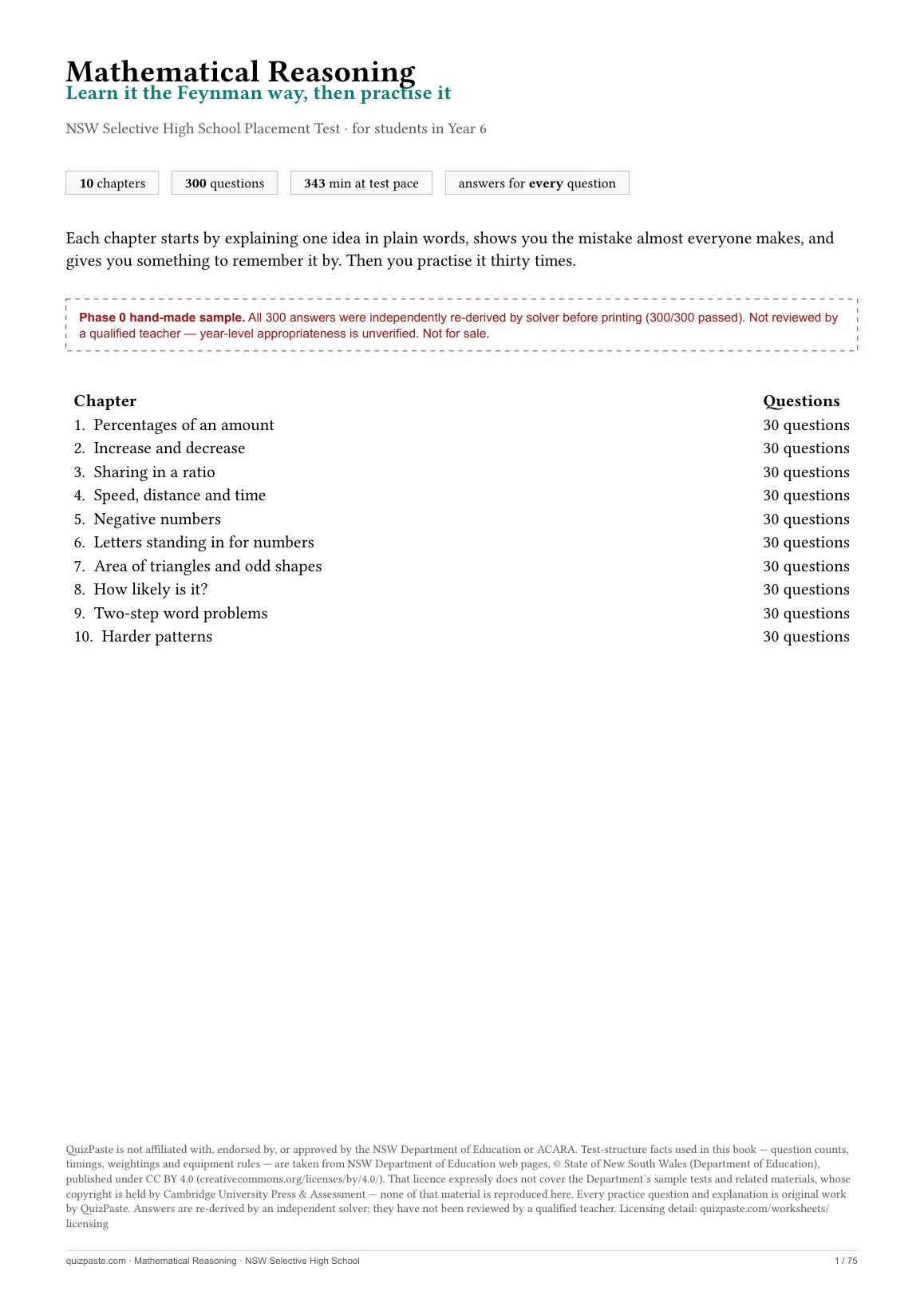
Cover of the Mathematical Reasoning practice book, showing the chapter and question count and a boxed note that the book has not been reviewed by a qualified teacher.Open the Mathematical Reasoning PDF
See 3 more pages inside
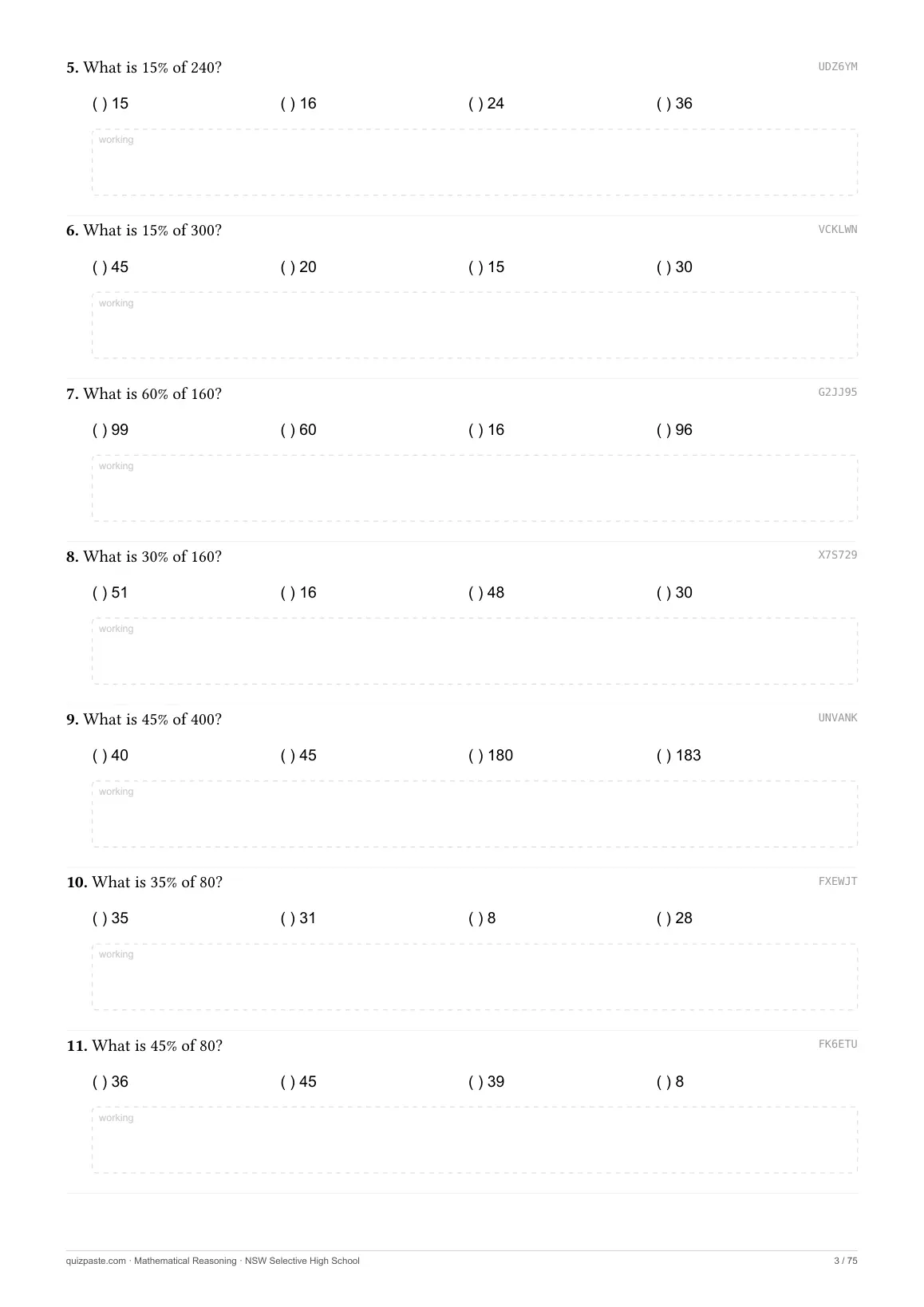
  1. A Mathematical Reasoning chapter opening page with five labelled boxes: In plain words, Example, Common error, Remember it like this, Check yourself.Open the Mathematical Reasoning PDF

    2 · Explain it in plain words

    Every chapter opens with the same five boxes: the idea in plain words, a worked example, the mistake it invites, something to remember it by, and one question to check yourself. If it cannot be said plainly, it is not understood yet.

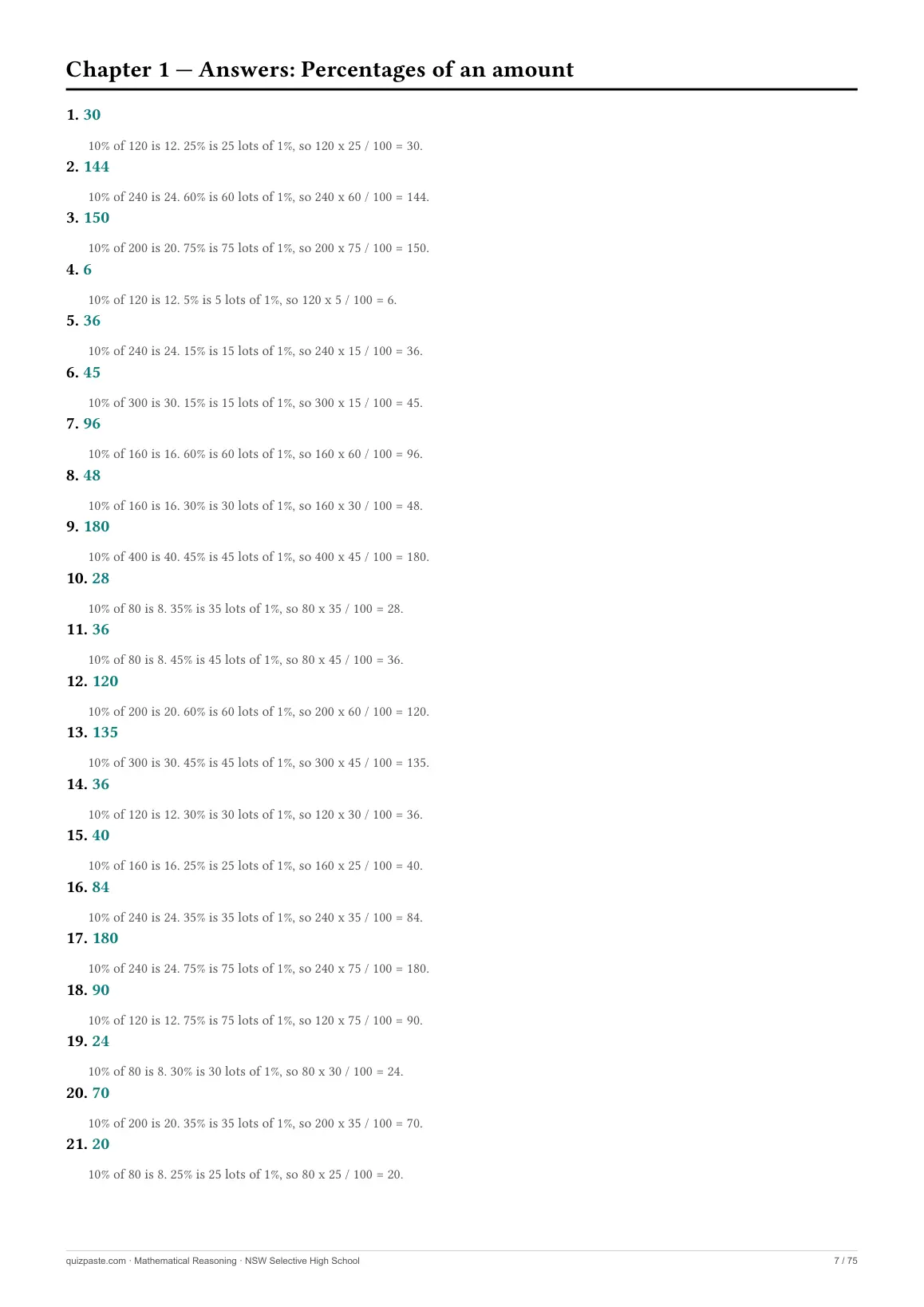
  2. A Mathematical Reasoning practice page: numbered multiple-choice questions, each with four options and space for working.Open the Mathematical Reasoning PDF

    3 · Then practise it

    Page after page on that one skill, four options each, with room beside every question for working. The same skill over and over, not a page of unrelated puzzles.

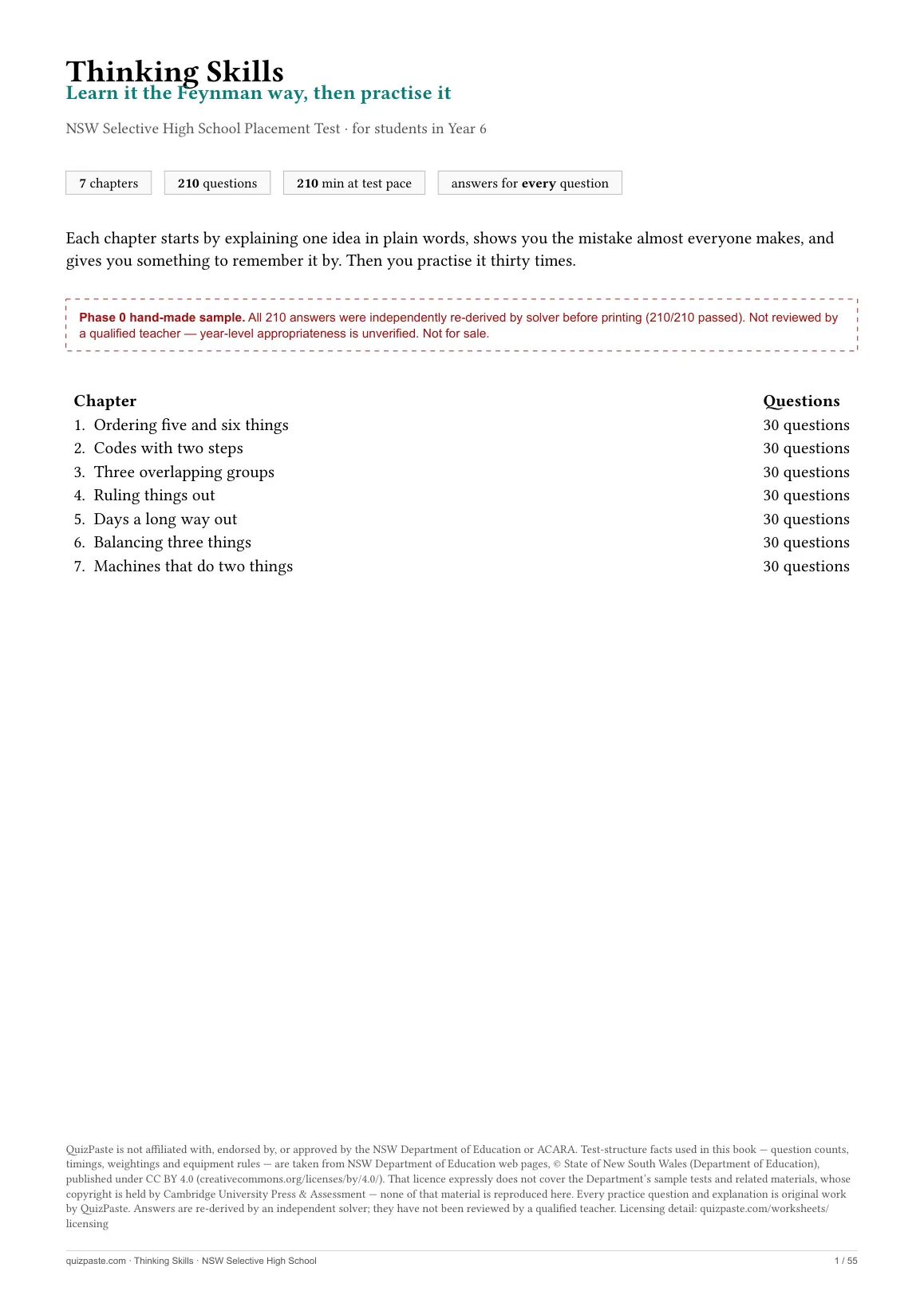
  3. A Mathematical Reasoning answers page: each answer followed by a line of working explaining how it was reached.Open the Mathematical Reasoning PDF

    4 · Check, and see why

    Every answer has the working, not just a letter. That is what lets a parent who is not a teacher explain where it went wrong.

Percentages of an amount · Increase and decrease · Sharing in a ratio · Speed, distance and time · Negative numbers · Letters standing in for numbers · Area of triangles and odd shapes · How likely is it? · Two-step word problems · Harder patterns

Download Mathematical Reasoning PDF

Free, no account and no email · 10 chapters

Thinking Skills

55 pages · 210 questions · answers & working for every one · 0.7 MB PDF

Cover of the Thinking Skills practice book, showing the chapter and question count and a boxed note that the book has not been reviewed by a qualified teacher.Open the Thinking Skills PDF
See 3 more pages inside
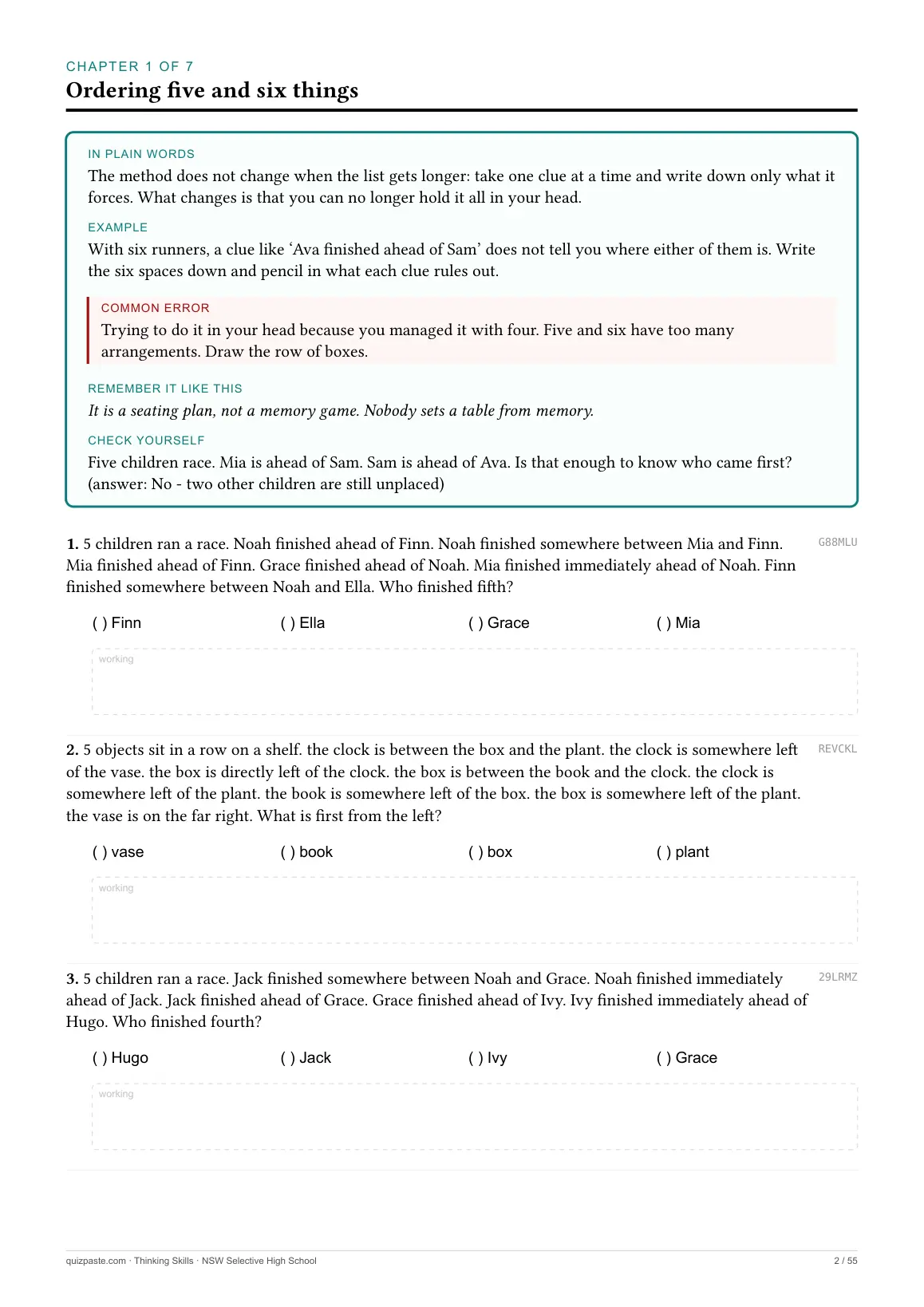
  1. A Thinking Skills chapter opening page with five labelled boxes: In plain words, Example, Common error, Remember it like this, Check yourself.Open the Thinking Skills PDF

    2 · Explain it in plain words

    Every chapter opens with the same five boxes: the idea in plain words, a worked example, the mistake it invites, something to remember it by, and one question to check yourself. If it cannot be said plainly, it is not understood yet.

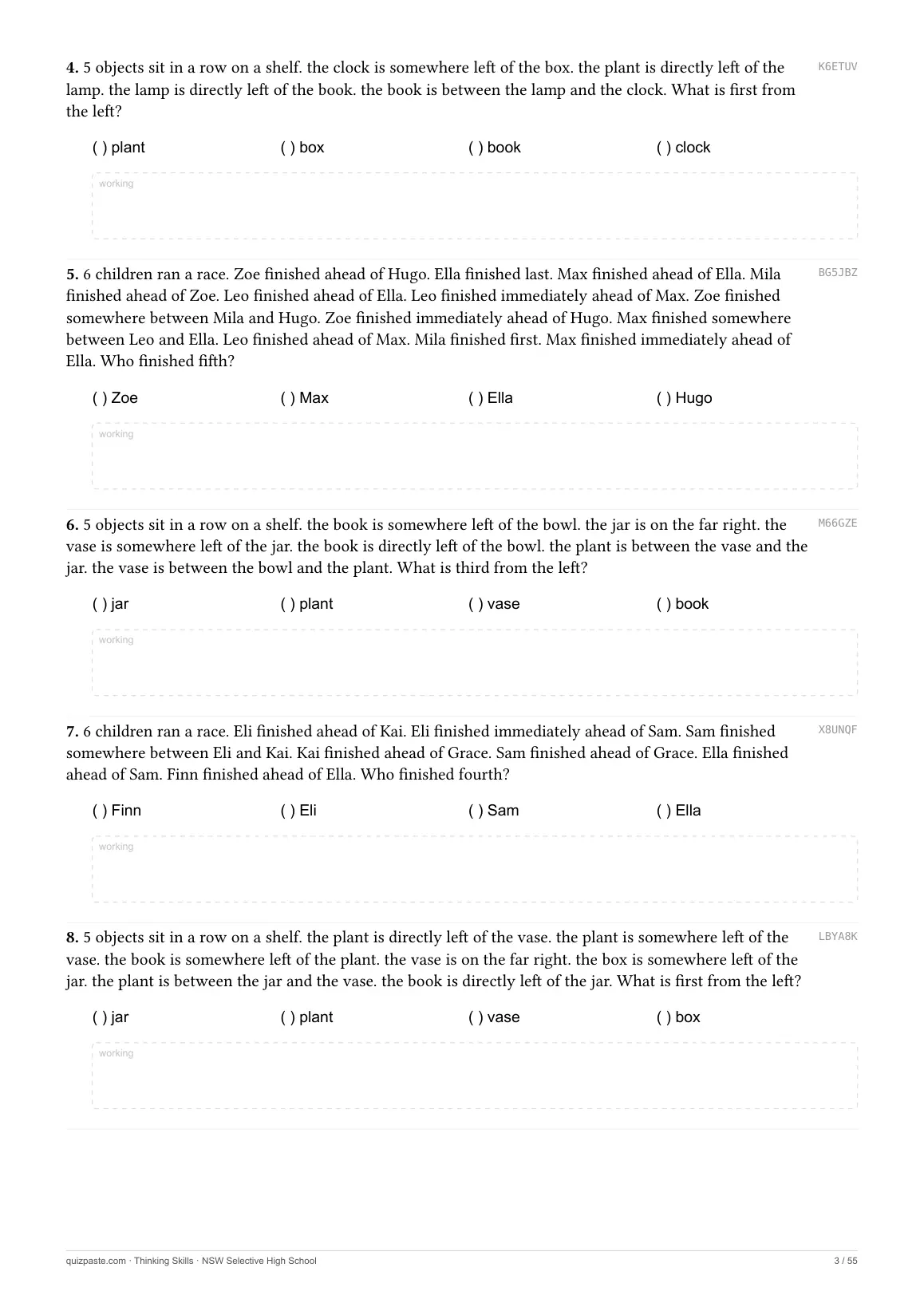
  2. A Thinking Skills practice page: numbered multiple-choice questions, each with four options and space for working.Open the Thinking Skills PDF

    3 · Then practise it

    Page after page on that one skill, four options each, with room beside every question for working. The same skill over and over, not a page of unrelated puzzles.

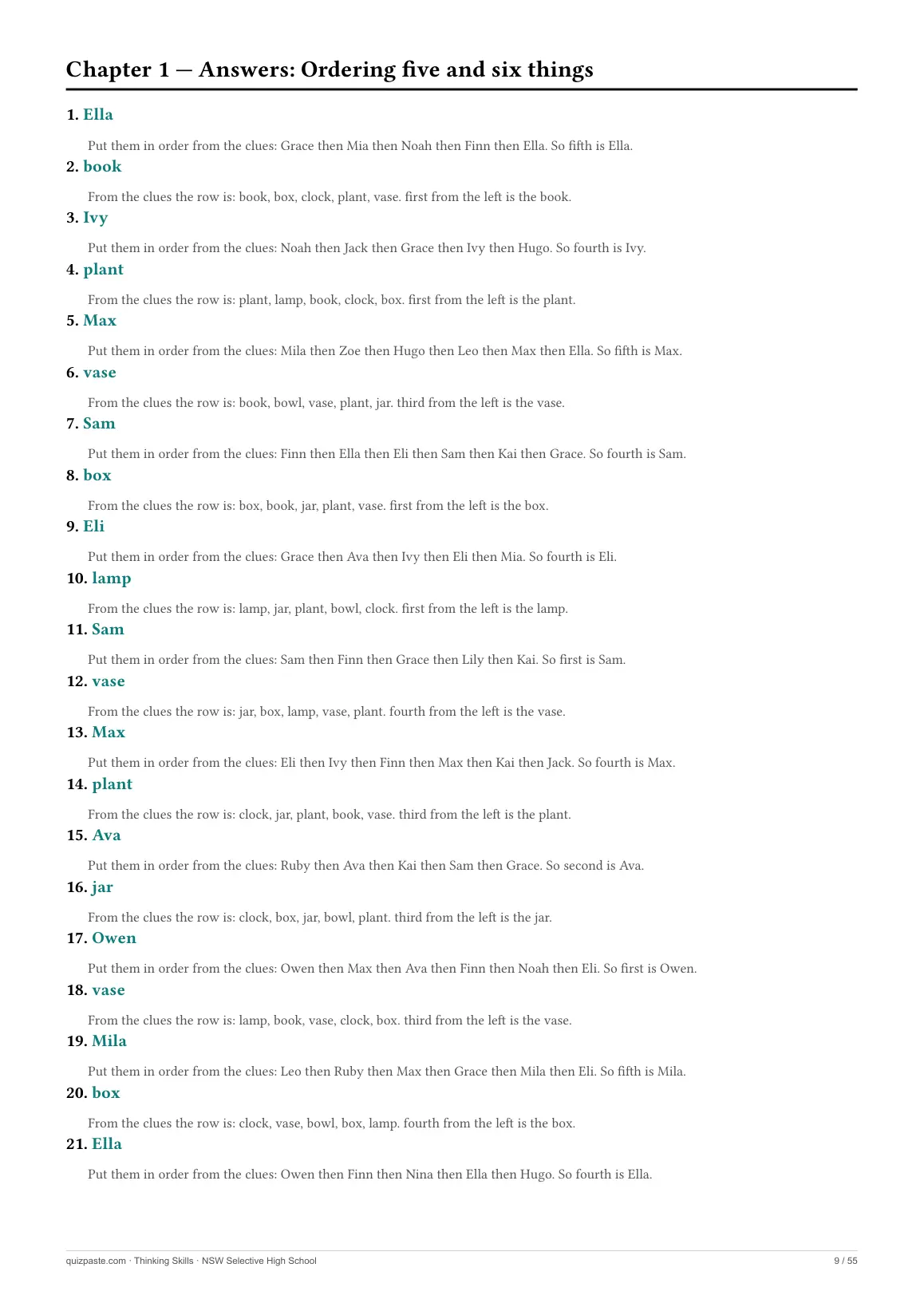
  3. A Thinking Skills answers page: each answer followed by a line of working explaining how it was reached.Open the Thinking Skills PDF

    4 · Check, and see why

    Every answer has the working, not just a letter. That is what lets a parent who is not a teacher explain where it went wrong.

Ordering five and six things · Codes with two steps · Three overlapping groups · Ruling things out · Days a long way out · Balancing three things · Machines that do two things

Download Thinking Skills PDF

Free, no account and no email · 7 chapters

The Year 4 books the checker keeps pointing you back at are on what is actually on the Opportunity Class test, and they are free in the same way. If you would rather work out what fits in a given evening than what fits in a year, the practice session builder does that for the Year 4 books.

Questions parents ask

Can my child sit the Selective High School test in Year 5?
No. The Selective High School Placement Test is sat in Year 6, for Year 7 entry — the Department says so on its placement test page. The test a Year 4 child sits is the Opportunity Class Placement Test, for Year 5 entry, which is a different test with three sections instead of four. If your child is in Year 5 they have missed the Opportunity Class window and the Selective test is the one ahead of them.
Is there free Selective test practice suitable for Year 5?
Selective test practice Year 5 families can genuinely use is thinner than it first looks, and our own two books are an example of why: they are free and complete, but they are written for Year 6. Our two Selective books are free and complete, but they are pitched at Year 6: the Mathematical Reasoning book opens on percentages, ratio and negative numbers. The checker on this page works out which of their chapters do not depend on something a Year 4 book teaches first, so you can start on those rather than on chapter one.
When should we start preparing for the Selective test?
We are not going to give you a month, because we do not know your child and nobody who does not know your child should. What this page can tell you is what starting early can usefully consist of when the main books are still a year ahead: closing the specific gaps that unlock them. The Department states that it does not recommend or endorse coaching for the placement test and that there is no credible research showing it helps a child gain entry.
What is the difference between the Opportunity Class books and the Selective books?
Level, mostly. The Opportunity Class books are written for Year 4 and stay inside what a Year 4 child has met: fractions of an amount, time, money, perimeter and area, order of operations. The Selective books are written for Year 6 and use percentages, ratio, speed, negative numbers, letters standing in for numbers and the area of triangles. The Thinking Skills pair differ by size rather than kind — ordering five or six things instead of three or four, codes with two steps instead of one.
How is the Selective test weighted?
All four sections are 25% each: Reading, Mathematical Reasoning, Thinking Skills and Writing. That means the single 30-minute writing question is worth as much as the 40-question Thinking Skills section. Nothing on this page helps with the writing, and our books cannot mark it either. We would not trust an automated marker with it: judging ideas, structure and expression is exactly the sort of call our checkers are built not to pretend they can make. That one needs a person to read what your child wrote.
Is the dependency map on this page official?
No. It is ours. We built it by reading our own two books’ chapter lists side by side and asking, for each Year 6 chapter, what the Year 4 book teaches that it stands on. It is not from the NSW Department of Education, it is not the Australian Curriculum, and no qualified teacher has reviewed it. Treat it as a reading order, not an assessment.
What to do with a wrong answer

Sources

  • Placement test — that the Selective High School Placement Test is for Year 7 entry and the Opportunity Class Placement Test is for Year 5 entry, which is what puts a Year 5 child on the Selective path.
  • Selective high school practice tests — the four sections, their question counts and minutes, and the 25% weighting on each.

Both re-checked 6 August 2026. QuizPaste is not affiliated with, endorsed by, or approved by the NSW Department of Education. The test-format facts here are taken from Department web pages, © State of New South Wales (Department of Education), published under CC BY 4.0. That licence does not cover the Department’s sample tests, whose copyright is held by Cambridge University Press & Assessment. Every question in our books, and the chapter map on this page, is ours. How we license our content →